-
-
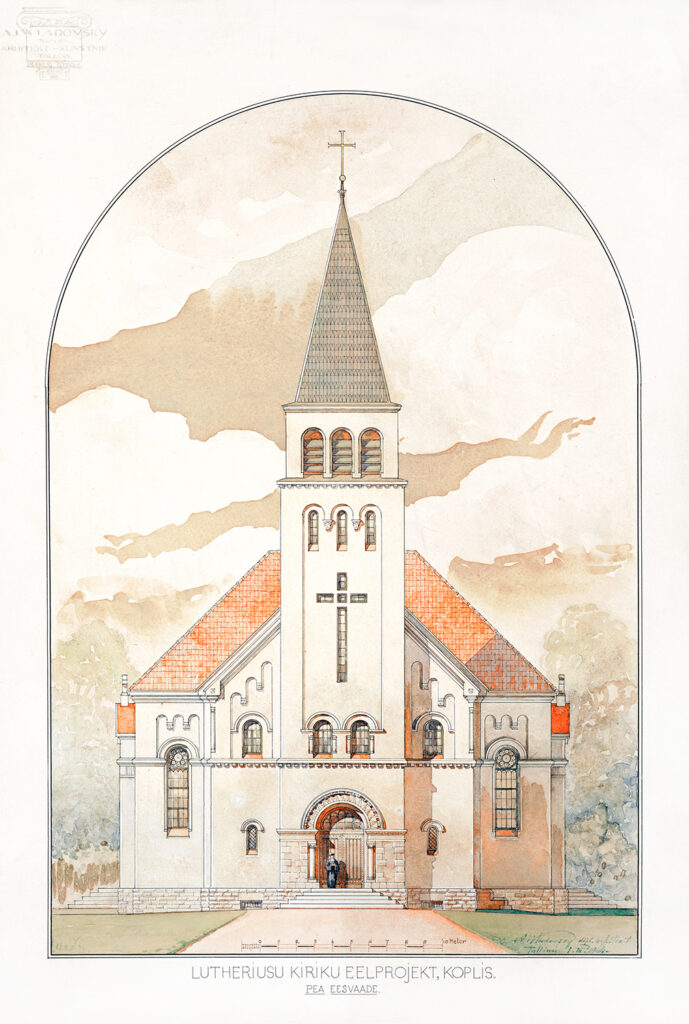
Preliminary project of the Lutheran Church in Kopli, 1944
Aleksandr Wladovsky, 1944. EAM 3.4.56
Lutheran church in Kopli, Tallinn
This church is a special milestone in church architecture, as one of the last designed sacral buildings before the Soviet occupation in 1944, which denied religion on an ideological basis. The construction of the Lutheran church was planned in the Bekker settlement in the late 1930s, when the congregation rooms proved to be too small for the expanding Kopli industrial settlement. Back then the area plan for the entire city district needed to be prepared before the church building could be designed. The location of the church was to be close to the Kopli Cemetery, on the edge of a new garden suburb. The preliminary project in watercolours was donated to the museum in 2012 by Hilja Väravas. Text: Sandra Mälk
-
-
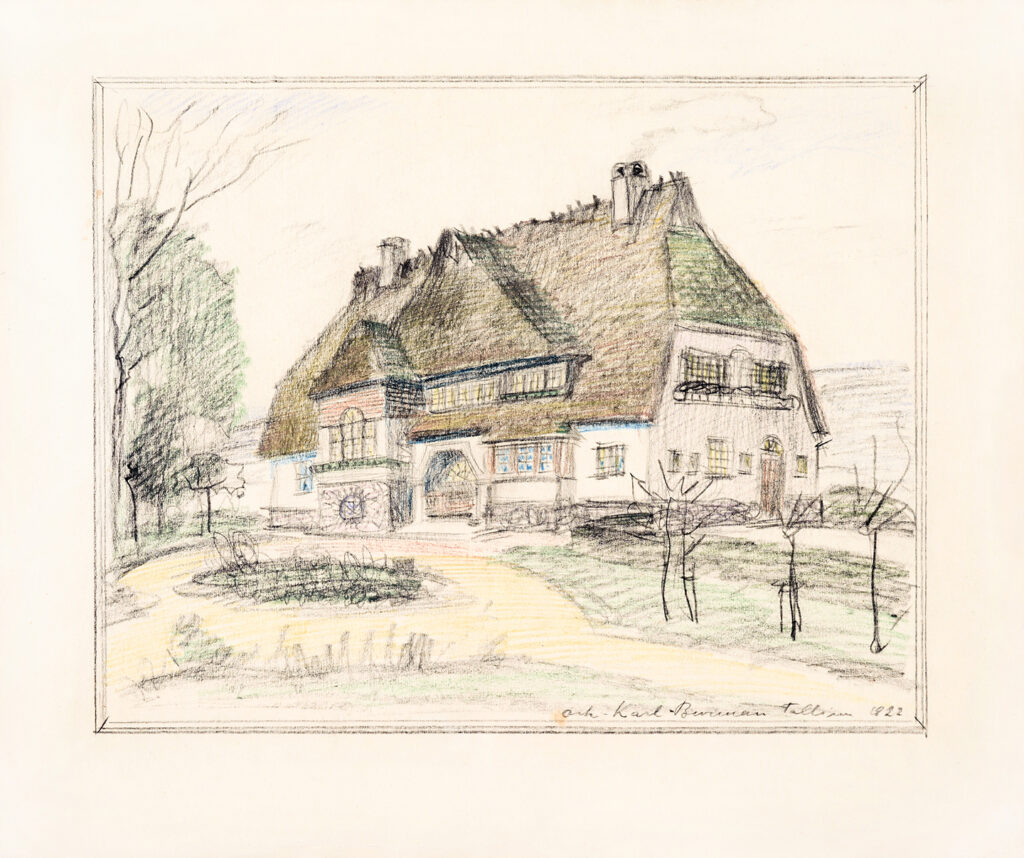
Drawing of August Hanko’s residence, 1922. Karl Burman
Karl Burman senior, 1922. EAM 2.2.695
Hanko’s house in Tartu County
The drawing depicts a dwelling in a farm in Kambja owned by journalist and entrepreneur August Hanko. At the time, Karl Burman favoured National Romanticism and drew inspiration from traditional Estonian farm architecture, using poetic elements to mitigate its practical nature. Burman’s oeuvre includes repeated elements in the form of bay windows, porches and a high-hipped thatched roof. Small grid windows of different sizes and shapes are also common to his work. As is characteristic to the style, Burman avoided excess practicality in the arrangement of space, placing a spacious hall in the centre of the layout and the living quarters surrounding it. The project was never realised.
Text: Sandra Mälk
-
-
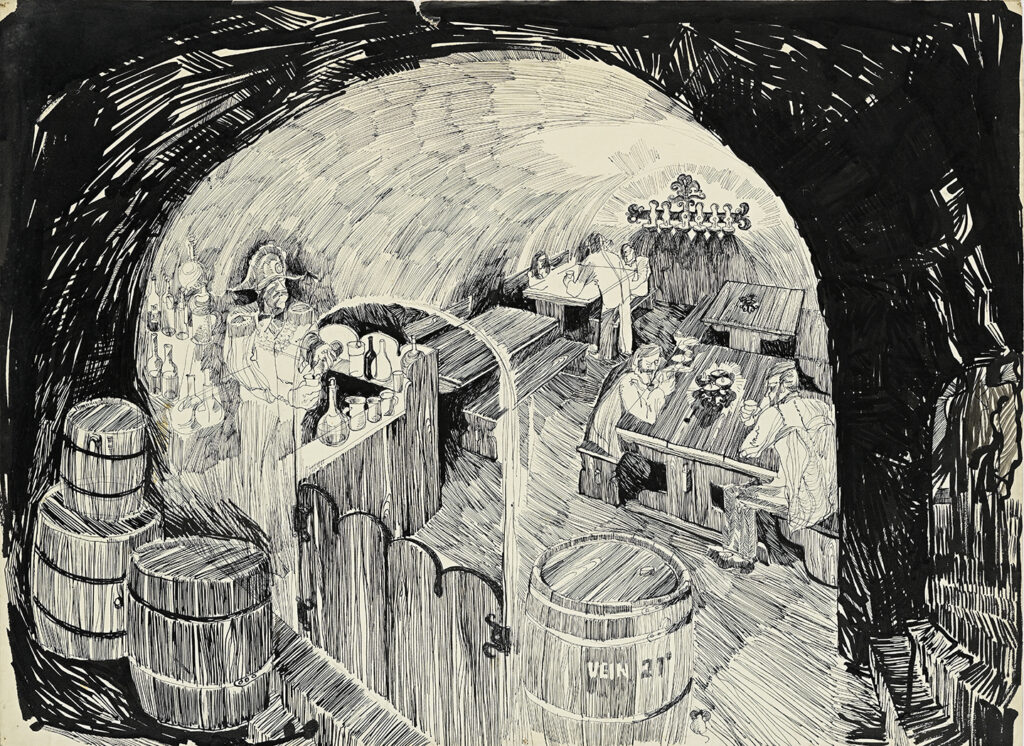
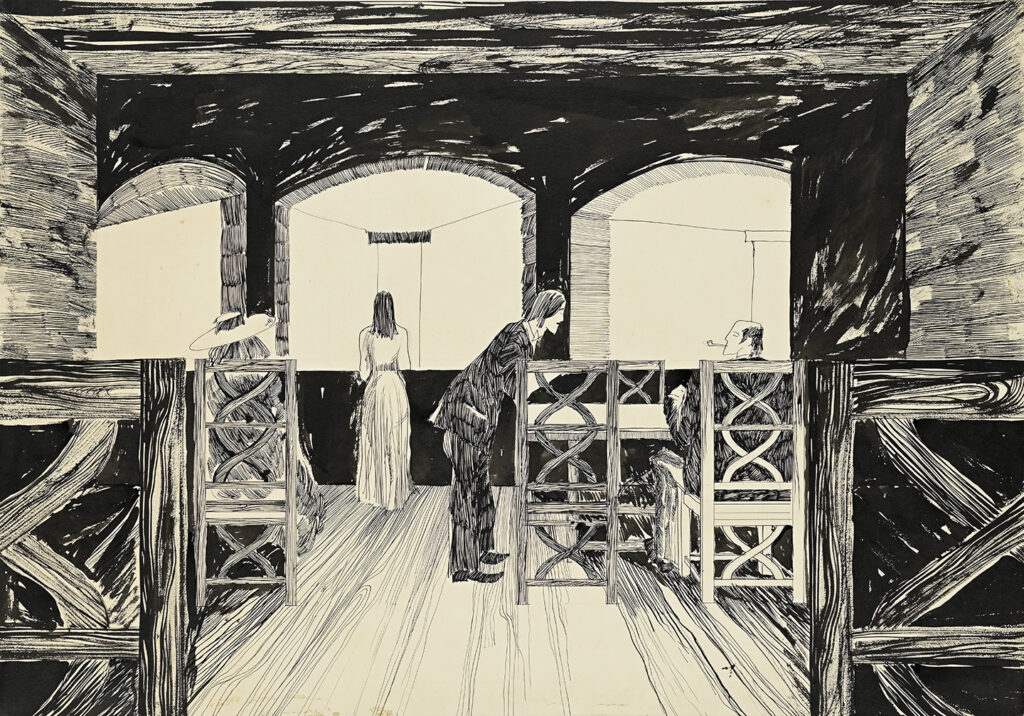
Interior design of Café Neitsitorn (Maiden Tower) in Tallinn. Aala Buldas
-
-
Interior design of Café Neitsitorn (Maiden Tower) in Tallinn. Aala Buldas
Interior architect Aala Buldas, 1970–1980. EAM 4.7.17
Café Neitsitorn (Maiden Tower)
One of the most unique defensive towers of the Tallinn city wall, the quadrilateral Neitsitorn (Maiden Tower) was restored in the 1970s. The Maiden Tower together with Kiek in de Kök were defensive structures of crucial importance in the defense of medieval Tallinn. However, after the loss of the status of Tallinn as a fortress city, the centuries-long defense function of the wall towers changed, and in the 19th century the wall towers were rebuilt into dwellings, as did the Maiden Tower. The two-storey residential building became a home for renowned artists and writers, whose apartments had several studio rooms. In the early 1970s, field research on the Tallitorn (Stable Tower) and the Maiden Tower began in order to find a public function for the building. The work was encouraged by the forthcoming Olympic regatta. During the reconstruction of the Maiden Tower, about half of the structure was rebuilt almost as new. The building was given a new floor, underground utility rooms and an impressive glass wall on the Old Town side. The Café Neitsitorn was situated in the new premises, which opened its doors to the public in 1980 and immediately became a big hit. The authors of the tower’s reconstruction design were an architect Tiina Linna, an art historian Villem Raam, and the café’s interior design was made by Aala Buldas. In 2022, the drawings were donated to the museum by Eva Mölder from the restoration company Vana Tallinn. Text: Sandra Mälk
-
-
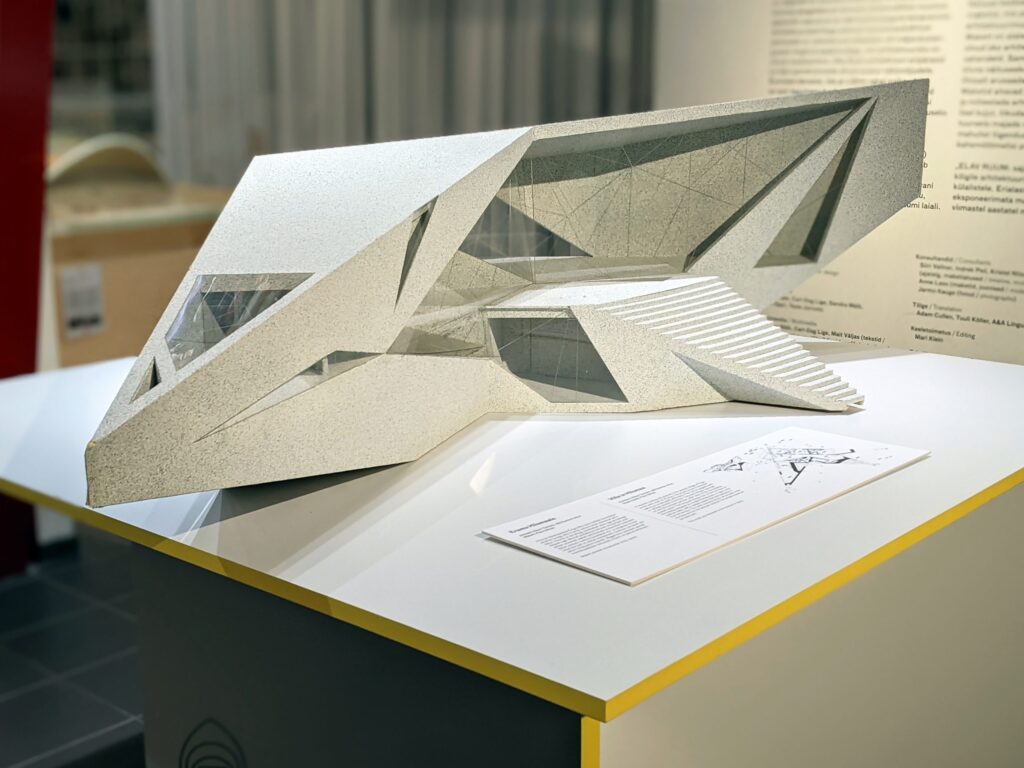
Villa in Hiiumaa. Villem Tomiste, 2004
Architect Villem Tomiste, AB Kosmos 2004. Model: Paco Ulman. EAM MK 121
EMA 30 / Tiny tour of models: Villa in Hiiumaa
A futuristic-looking villa planned in the seaside village of Õngu on the west coast of Hiiumaa. The private house is characterised by an accentuated artificiality. There are no aligned walls or ceilings parallel to the floor. Variously shaped openings cut into the fractured surfaces, offer views of the surrounding unspoilt nature. The living and dining room on the second floor of the building, designed as a single flowing space, is open to the seafront reeds, with a wedge-shaped staircase leading to it from the terrace. This private house has not been built. The model was donated to the museum in 2005. Text: Anne Lass
-
-
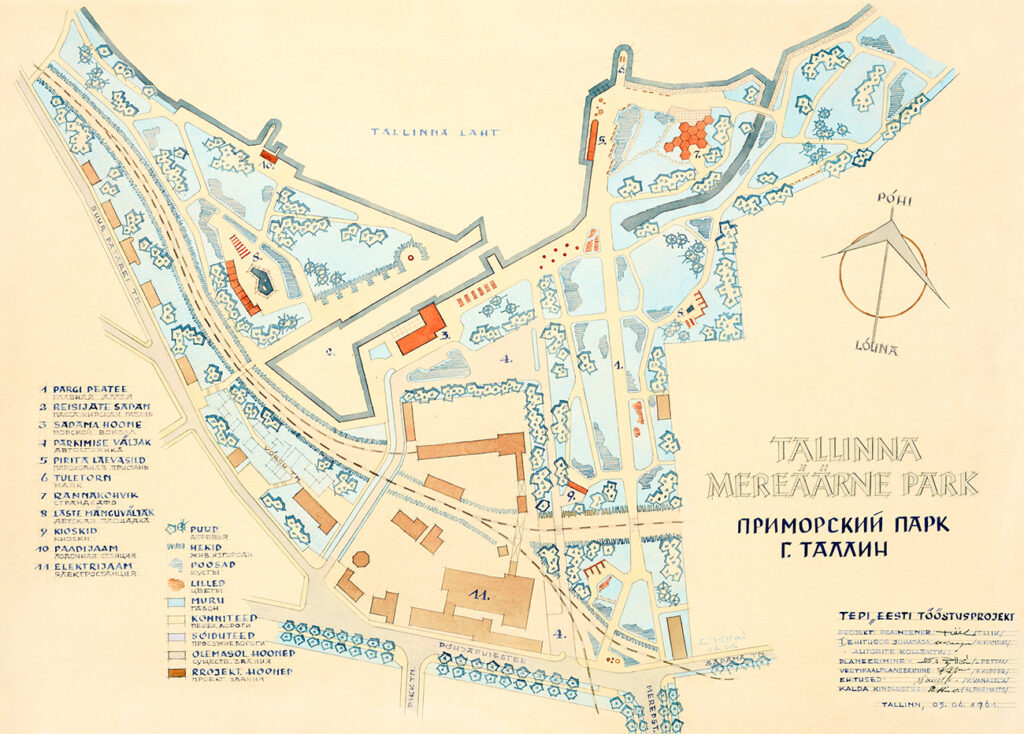
Tallinn Waterfront Park, 1960
Lidia Pettai, 1961. EAM 15.4.150
Seaside park in Tallinn
60 years ago, the opening of the Tallinn sea border was under discussion with the intention of turning it into a green area with port facilities. Back then, In the 1960s, and primarily at Finland’s initiative, plans were made to clear up all the areas surrounding the port with regard to the reopening of the Tallinn-Helsinki seaway and the construction of the passenger port. The seaside area – in the immediate proximity of Old Town – was partly in the military zone and opening it up to the city became a lively issue. Although, only a handful of buildings were fixed up during the Soviet era. New buildings were due to be constructed in the densely built-up industrial area together with the main park road that was in the direction of Mere Boulevard (No. 1), such as the beach café (7), the port building (3) and children’s playgrounds (8). A team of architects worked with the design at the Eesti Tööstusprojekt. Kalju Vanaselja designed the buildings and H. Parmasto behind the schemes of coastal reinforcements. The plan was designed by architect Lidia Pettai, whose watercoloured work was given to the museum in 2012 by Reet Priilaht. Text: Sandra Mälk
-
-
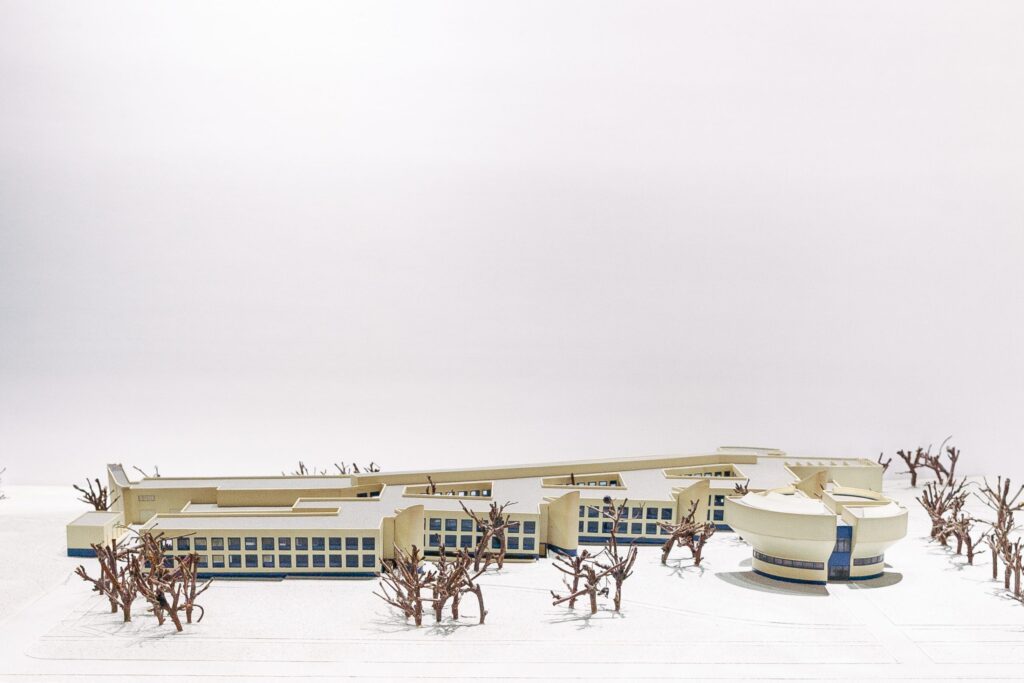
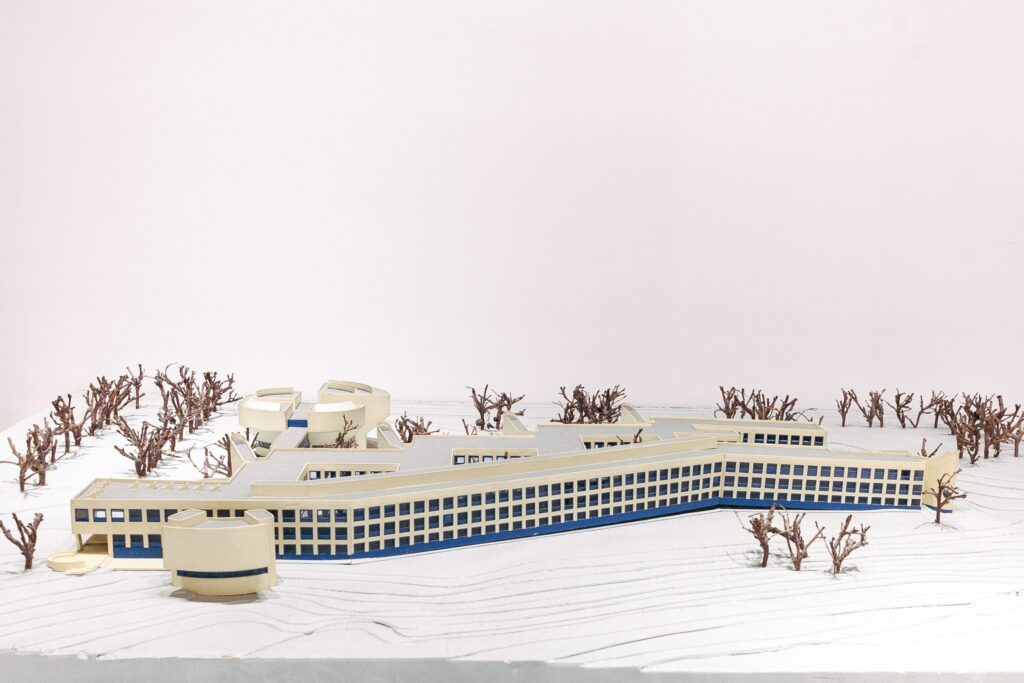
Estonian Agricultural Academy (currently Estonian University of Life Sciences) in Tartu. Valve Pormeister, 1976
-
-
Estonian Agricultural Academy (currently Estonian University of Life Sciences) in Tartu. Valve Pormeister, 1976
-
-
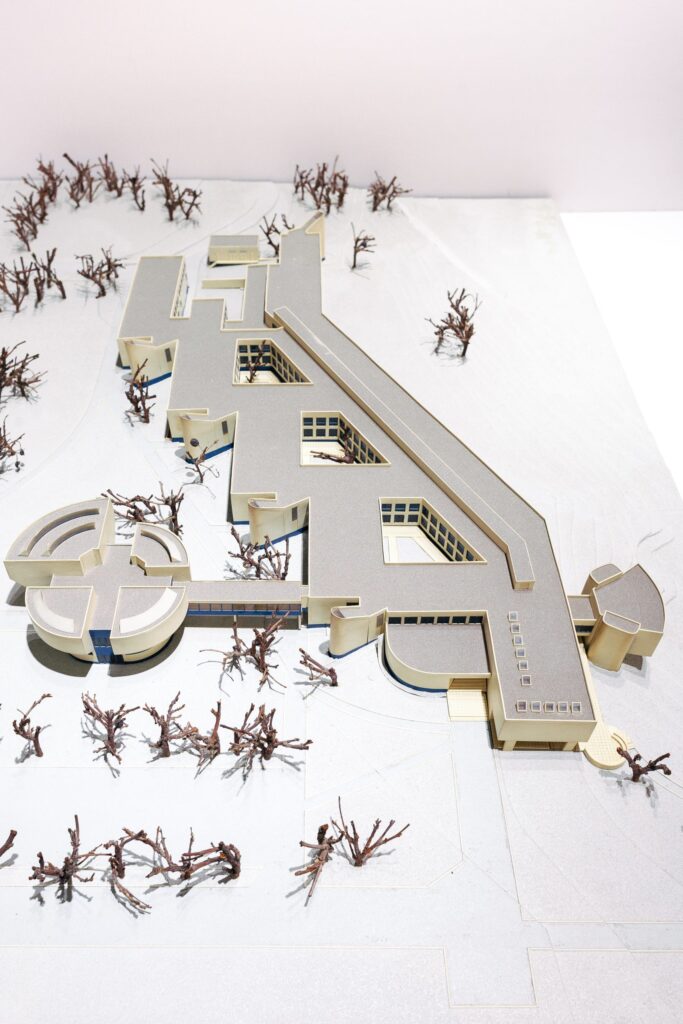
Estonian Agricultural Academy (currently Estonian University of Life Sciences) in Tartu. Valve Pormeister, 1976
Valve Pormeister, 1979. EAM MK 248
EMA 30 / Tiny tour of models: Estonian Agricultural Academy (currently Estonian University of Life Sciences) in Tartu
The construction of the new building complex for the Estonian Agricultural Academy in Tähtvere at the north-western border of Tartu was already launched in the 1960s. The Faculty of Forestry and Agricultural Mechanics building, designed by architect Valve Pormeister, was completed in 1983. This was one of the largest new buildings in Tartu, and the one with the most complex layout. The building consists of two contrasting structures intersected by three trapezium-shaped courtyards. The stepped main facade is articulated by round windowless stairwell towers, while the part of the building facing the river has a more laconic design. The massive circular auditorium was never built. The model was handed to the museum by the Estonian University of Life Sciences in 2019. Text: Anne Lass
-
-
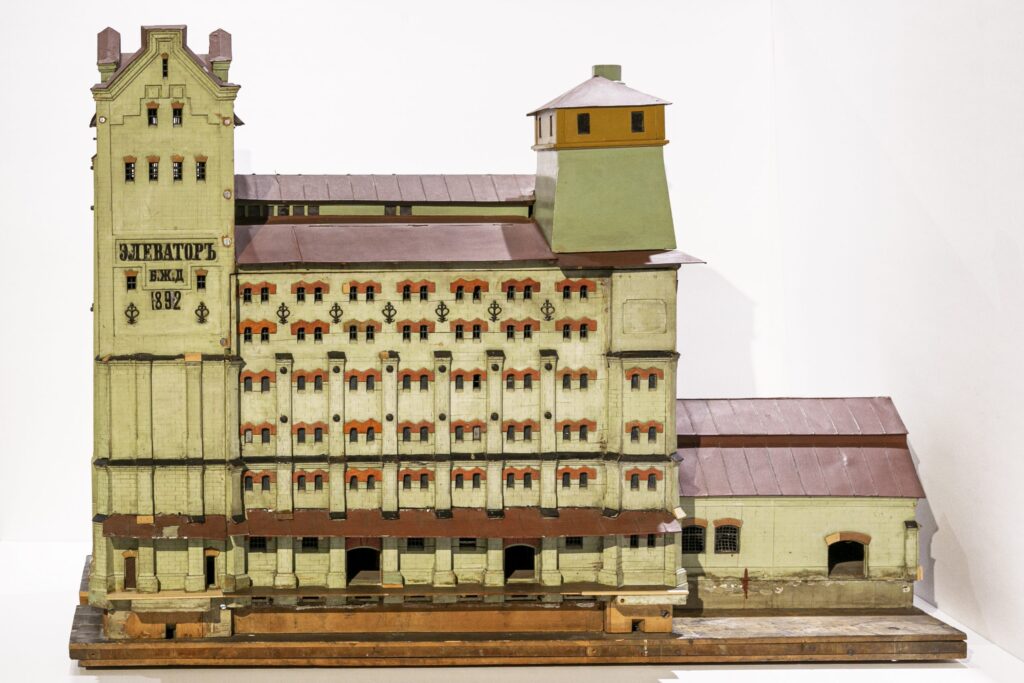
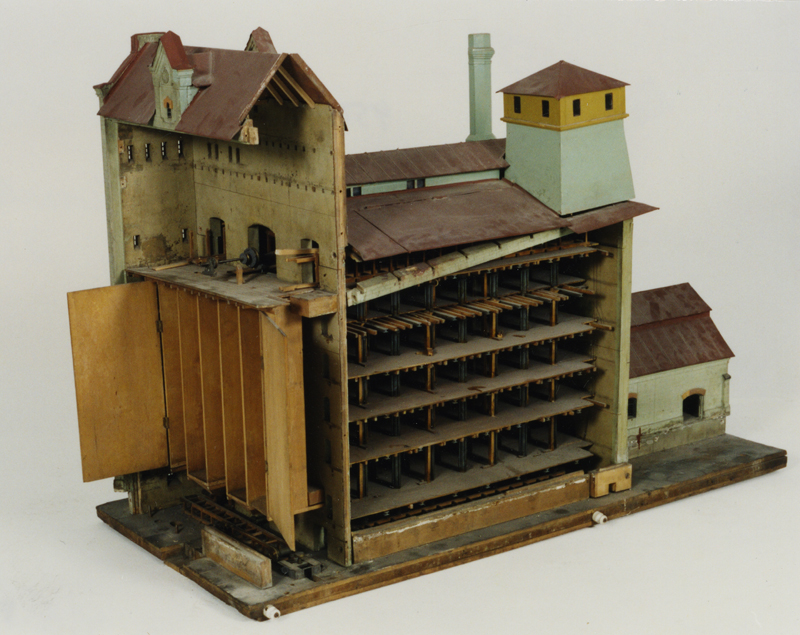
Model of the grain elevator in Tallinn harbour, 1899
-
-
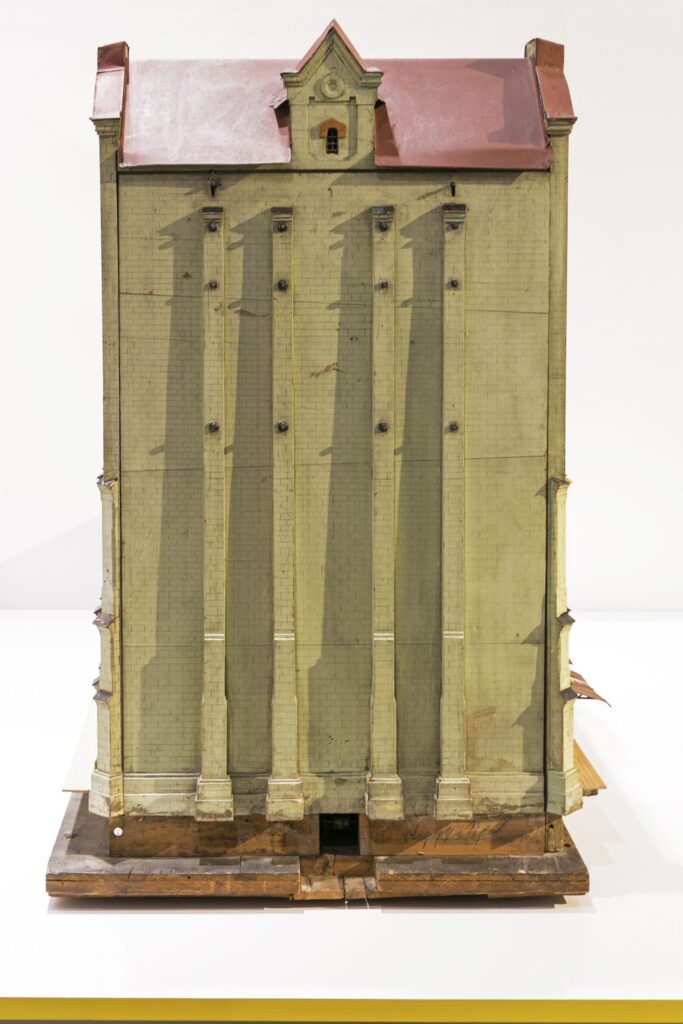
Tallinn harbour grain elevator, side view of model, 1899
-
-
Tallinn harbour grain elevator
-
-
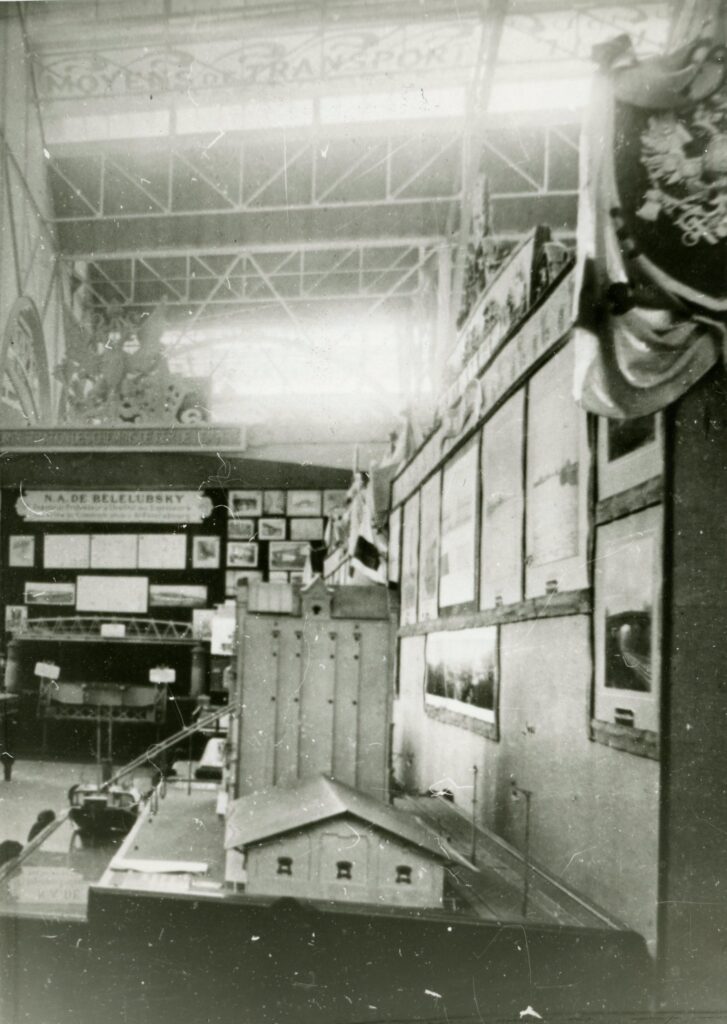
Model exhibited at the Paris Exposition Universelle, 1900
-
-
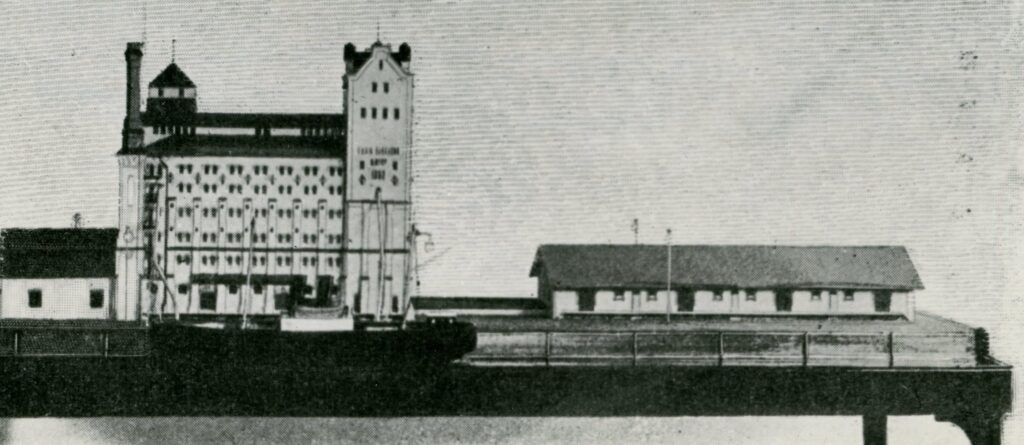
In the catalogue of the Ministry of Roads Museum, 1902
Anton Klevchshinsky, Feodor Yenakiyev, 1892–1893. Scale model: J. Kangro, K. Asik (woodwork), Krasimoshev, O. Sakker (metalwork), 1899. EAM MK 61
EAM 30 / Tiny tour of models: Tallinn harbour grain elevator
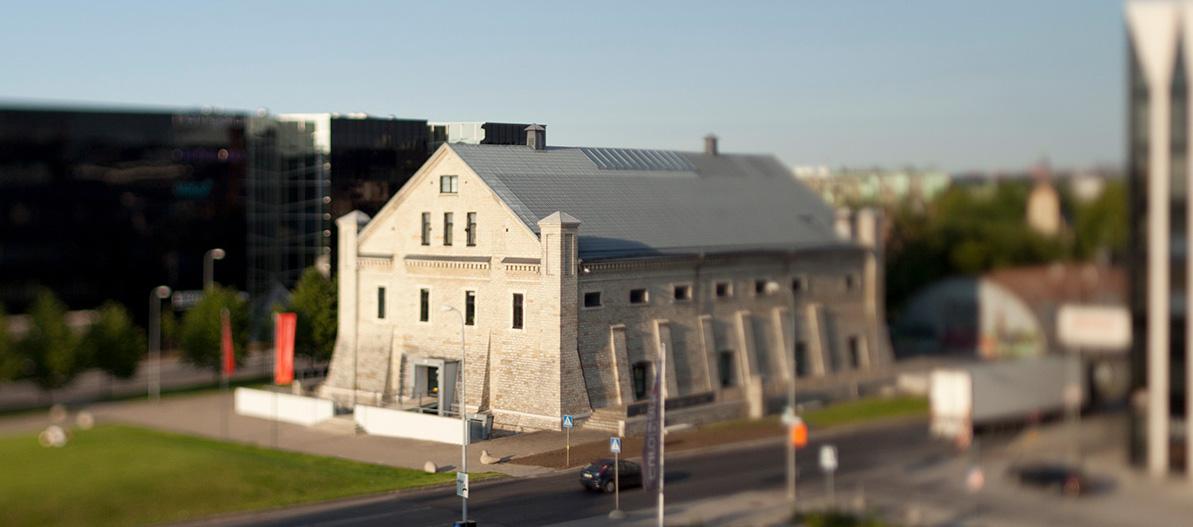
In 1893, a huge 6-storey limestone grain elevator with a 30-metre tower was completed on Viktoria quay at the harbour in Tallinn. At the time it was one of the largest and most modern in tsarist Russia, holding more than 3,000 tons of grain that could be mechanically loaded directly from wagons to ships. The elevator was designed by architect and academic Anton Klevchshinsky and engineer Feodor Yenakiyev, both from St Petersburg. A model of the building was completed in 1899 and was shown a year later at the 1900 Paris Exposition. The model is extremely detailed, there are various mechanisms in the interior that were originally able to move. The scale model’s journey to the Museum of Estonian Architecture has been a long one. After the exposition in Paris it was given to the Museum of the Ministry of Transport in St Petersburg. In 1971, the model came to Estonia and for 30 years was on display at the Railway Museum in the main building of Baltic Station. From there it found its way to the Estonian History Museum which, in 2000, donated the model to the Estonian Museum of Architecture. The model was restored by Kanut restorers. Text: Anne Lass