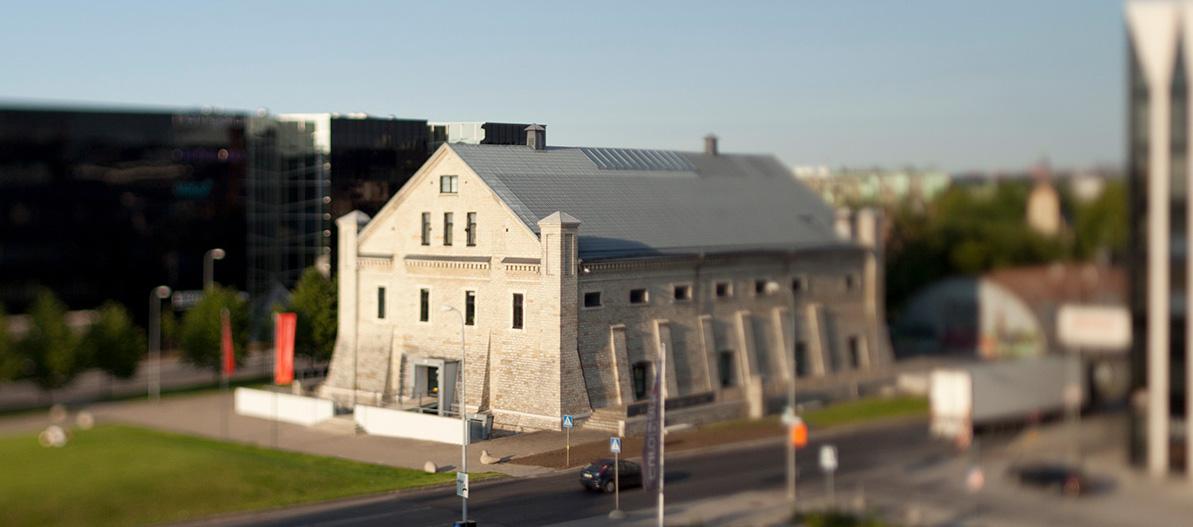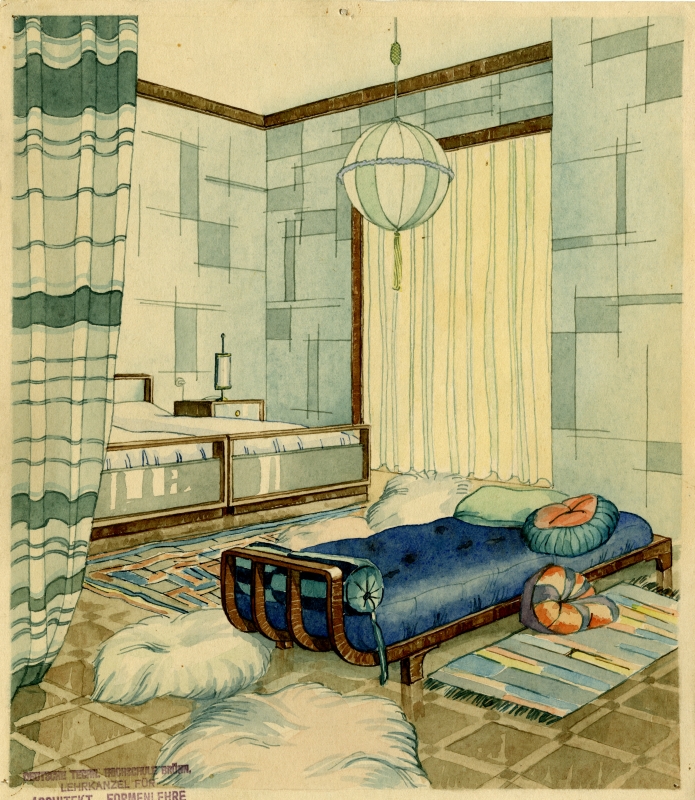
Ernst Kesa schoolwork at German Technical University in Brno, ca 1933. MEA 12.2.7
Ernst Kesa and His Studies at the German Technical University in Brno
Ernst Kesa studied in Brno during the first half of the 1930s, when the university’s golden era began to face the impact of the economic crisis. The local German Technical University was exceptionally popular among international students, who made up nearly half of its 1,740 enrolled students. This high interest was due to instruction conducted entirely in German, as well as the school’s excellent reputation as a scientific institution competing with Vienna. For Estonian students, this environment was a natural choice: thanks to Estonia’s Baltic-German history, German was a common second language, so there was no language barrier.
The first twelve Estonian students enrolled in 1924, and their numbers grew steadily. A major boost came in 1929 with the introduction of visa-free travel between Czechoslovakia and Estonia. For Estonians, the German Technical University in Brno became the second most popular European university after Danzig (Gdańsk). They were attracted by the high quality of education and the relatively low tuition and living costs compared to Western Europe. During the interwar period, Estonian students made up an average of 2.2% of all foreign students at the school.
Ernst Kesa and his brother August, who studied insurance science at the university, entered a prestigious and distinctly international environment in early 1930s. During their studies, the school underwent significant modernization. A clear example was the opening of the brand-new student canteen on Údolní Street, designed by Professor Vinzenz Baier, which provided very affordable dining.
Housing options varied dramatically depending on the students’ finances. The most popular place was the comfortable Lindenheim student dormitory beneath Špilberk Castle. In contrast, the Fischerheim dormitory served as a harsh temporary residence without basic amenities, where up to 30 people shared a single room. From December 1933, the Neuer Heim dormitory on Lipová Street offered better living conditions. Students who could not secure a spot in the dormitories had to rent private rooms, which were often twice as expensive and usually offered only small, dark quarters.
However, the greatest burden was the cost of studying itself. Foreign students paid double the tuition of local Czechoslovak students and were subject to an additional fee for foreigners. As the economic crisis deepened, studying became up to four times more expensive for international students, leading to a massive outflow after 1932. Since the Kesa family came from a modest rural background and was not wealthy, it is likely that the brothers received scholarships—either from the Estonian government to support young experts, or directly from the school, which offered financial aid to talented students.
The curriculum at the Brno Technical University was different from today’s system. Students had to personally visit individual instructors to register for specific lectures or practical courses, and have their enrollment confirmed by the professor’s signature. Ernst Kesa thus studied at the institutes of structural engineering, bridge building, and technical drawing. He studied technical drawing under Emil Tranquillini, an architect and a respected educator originally from Vienna, who gained great authority in Brno and eventually became a dean and rector. Alongside technical drawing, he taught students architectural ornamentation and lectured on medieval building techniques. Education at this prestigious yet traditional institution required absolute precision, which remains evident in Kesa’s surviving student drawings today. The education relied not only on theoretical lectures, but hands-on training played a crucial role. Students spent a significant amount of time in drawing rooms, laboratories, and workshops.
However, the German Technical University did not have an easy position in interwar Brno and faced opposition from the Czechoslovak public. There was strong local rivalry with the parallel Czech Technical University, which was recognized as a global center of modern functionalist architecture. Czechoslovaks viewed the German Technical University with distrust, seeing it as a conservative symbol of the old Austro-Hungarian Empire that remained isolated from the city’s Czech majority and the ideals of the new republic. These social tensions further escalated during the 1930s with the rise of Nazism in Germany.
Schoolworks of Ernst Kesa made at German Technical University at Brno in 1931–1936 were donated to the Estonian Museum of Architecture by the architect himself at 1992 among with multiple projects and photos (82 archivals). Personal fond 12 – Ernst Kesa was created.
Text: Lucie Janečková